Trying to track your daily food intake, personal nutrition, and weight loss goals on a mobile device can quickly become an exercise in frustration. Many individuals looking for medical weight loss solutions or high-protein macro trackers start out highly motivated, only to get bogged down by clunky interfaces, massive databases that require a constant internet connection, or apps that drain the phone battery before lunchtime. It is a common problem in the digital health category; tracking tools often require too many manual taps just to log a single glass of water or a simple health food breakfast plate.
This is where MyFitnessPal comes in to help ease the daily hassle of clinical calorie counters and health monitoring. The application serves as a digital calorie counter and exercise log designed to keep a running count of your daily calories, macronutrient targets, and physical activities. Instead of writing everything down in a notebook or guessing the nutritional value of your meals, the app provides an extensive database of items to help you monitor what you consume throughout your daily health coaching routine.
In my view, the app tries to simplify a chore that most people find incredibly tedious. During my time checking out its mobile health software, I wanted to see if it actually makes daily corporate wellness tracking easier for an ordinary phone user or if it just adds another layer of screen clutter and device slowdowns to your diet planner routine.
📱 My Phone Testing Setup
To see how the application performs under normal, everyday conditions, I installed it on my personal Redmi Note 13 Pro. My device runs on the Android 14 operating system with the HyperOS customization layer on top. I used the app consistently over a full 2-day testing window while keeping my usual background apps active, such as telehealth tools, email notifications, and music players. I toggled between my home Wi-Fi network and standard mobile data networks while moving around my local area to see how the software handles changing connection strengths under normal multi-app multitasking routines.
🎬 Real-World Hands-On Analysis
Logging a Home-Cooked Breakfast
On my first morning, I attempted to log a custom breakfast consisting of three scrambled eggs, two slices of whole wheat toast, and a black coffee. I tapped the add button in the food diary menu and used the text search box to find each item. The app pulled up matching results in under a few seconds, allowing me to adjust the macronutrient percentages smoothly before saving. The interface layout felt easy to understand during this task, and it took me under 1 minute to log the entire medical nutrition meal from my kitchen table.
Scanning a Package Barcode at the Grocery Store
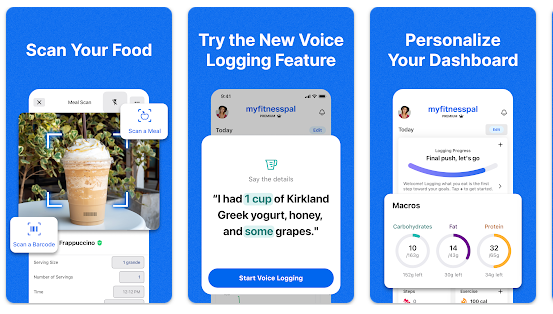
Later that afternoon, I tested the barcode scanner feature on a container of plain Greek yogurt I bought at the store. I granted temporary camera access when prompted by my phone screen, held the container under my camera lens, and waited for the app to respond. The software accurately recognized the product code in a few seconds and automatically populated the exact calorie and protein numbers on my display without requiring any manual typing.
Logging a Running Exercise and Toggling Menus
On my second day, I tracked a 30-minute outdoor jog by opening the exercise log diary. I manually entered the duration and intensity of the run under the cardiovascular training section. While walking back home, I quickly switched between the main dashboard, the macro tracking chart view, and the water intake log to see how the layout handles rapid menu swapping. The text elements and progress rings updated without screen freezing, though a premium upgrade pop-up appeared when I tried to look at some advanced nutrient timing tabs.
📊 App Permissions & Device Safety
When you install MyFitnessPal, the software will trigger specific hardware access prompts on your screen depending on which features you try to use. These prompts occur because the application needs to interact directly with your physical components to process photos, search networks, or register inputs.
Here is the objective breakdown of the tracking permissions presented during my 2-day view:
| Permission Type | Required? | True Technical Purpose |
| Storage & Device Media | Optional | The app did not explicitly demand full storage pool read/write permissions during my testing window to save base text inputs. |
| Microphone & Audio Core | No | During my testing, the app did not request microphone or audio hardware access prompts on my screen. |
| Camera Hardware Access | Optional | Requested only when I tapped the barcode icon to scan product labels; it uses the lens to capture the graphic lines. |
| Network & Wireless Access | Yes | Required to connect to the central product database, pull down search results, and sync diary modifications. |
| Location & Proximity Flags | Optional | The app did not request location permission during my testing window to log daily food or cardiovascular exercises. |
📊 Speed & Everyday Performance
The overall responsiveness of the application feels quite snappy during basic text entry and diary updates. Moving between the primary food diary tab and the main progress dashboard happens with fluid scrolling, and the screen elements adapt quickly when you flip your device orientation. I did not notice any heavy stutters or sudden page jumps while moving through the standard food lists.
Here is the performance summary based on my real-world observations:
| Performance Test | My Real-World Observation |
| Initial Download & Install Time | Around 1 minute on a standard home broadband connection. |
| First Open & Setup Speed | Takes around 1 minute due to mandatory goal configuration questions. |
| Menu Smoothness & Scrolling | Fluid scrolling across standard diary rows with snappy tab shifts. |
| Memory Load & Slowdowns | Average memory load; background applications remained steady in my tray. |
| Battery Drain While Active | Moderate battery consumption during extended database searches. |
| Phone Warmth & Heating | The phone processor area remains completely cool during casual entry loops. |
| Background Behavior Upon Exit | Pauses cleanly when swiped away, keeping notification counters steady. |
| Stability & Bug Resilience | Completely stable during my testing; no system crashes occurred. |
💾 Storage Space & Cache Build-Up
According to the official Google Play Store listing, the initial download package size for MyFitnessPal sits at exactly 46.54 MB. However, after the installation script unpacks the core files onto the device storage drive, the base application takes up exactly 163 MB of disk space on my Redmi phone before adding any personal diary data.
As you use the application to search for custom foods, view product images, and log recipes, the data folder begins to collect temporary cache files in your phone settings menu. After my 2 days of regular logging, the cache folder grew by an additional 12 MB. While this is lightweight on a modern smartphone, users with limited internal space should clear it out manually through their phone settings menu every few months to prevent the app folder from expanding unnecessarily over long periods of use.
🔋 Battery Life & Daily Warmth
During active screen-on usage—such as building custom meal recipes or scrolling through detailed nutritional breakdowns—the application exhibits moderate battery consumption. It does not run down your cell power like a mobile video game or a navigation map, but leaving the screen open inside the database search menu for a long time will cause a noticeable, standard battery drop. When my device sat on standby on my desk, the background behavior felt highly optimized, showing very little battery wear over several hours.
My phone processor area remained cool to the touch during quick logging sessions. The only time I noticed mild warmth was during a continuous 15-minute session where I was rapidly scanning barcodes and saving complex custom recipes back-to-back under a weak cellular signal.
tipzoom.in Quick Tip: To save your battery while tracking meals on the go, turn off the constant push notifications and community update alerts inside the app’s notification settings menu.
🌐 Network Needs & Data Usage
MyFitnessPal relies heavily on an active internet connection to access its massive online food library. While the app can open your diary entries when your phone drops into a dead zone, searching for new nutritional entries requires steady network access.
- Initial Setup Access Cost: Requires an active data connection to register a profile, verify your target weight metrics, and download the initial local asset configurations.
- Daily Usage Data Footprint: Uses a low to average amount of cellular data during a typical session, as it mainly transfers text files and small product information packets.
- Additional Asset Downloads: The application runs completely from the base package and does not force massive extra asset downloads after installation.
- Offline Support: You can view your current day’s saved diary entries and log standard items from your historical recents list offline, but keyword searches and barcode verification require internet access.
🛡️ Monetization & User Security Review
According to the app’s Play Store Data Safety section, the developer states that specific user data types—such as approximate location, personal identifiers, fitness metrics, and app performance logs—may be collected and shared with third parties for advertising and analytics purposes. The app forces profile account registration during the first launch; you cannot use a clean guest access mode to bypass the setup screens, meaning you must provide an email address to use the utility.
The monetization strategy relies heavily on a freemium model. The free tier contains programmatic inline banner advertisements at the bottom of your diary pages and occasional full-screen pop-up countdowns promoting the premium version. Many advanced tracking metrics—such as deep macronutrient breakdowns by meal, the barcode scanner in certain regions, custom calorie goals by day, and ad-free browsing—are locked behind an aggressive premium paywall subscription.
🛠️ Mistakes I Noticed During Testing
Convoluted Serving Size Adjustments
During my first day of logging home-cooked meals, I found the serving size selection menu to be unnecessarily confusing. When trying to log a custom amount of sliced almonds, the app forced me to alternate between decimal fractions and specific gram options across two separate drop-down tiers. It is easy to make a user error here and enter double the actual amount if you do not double-check the decimal points carefully.
Inline Advertisement Layout Overlap
While scrolling rapidly through my dinner diary logs on the second evening, a programmatic banner advertisement loaded directly over the “Add Food” button row. This caused a momentary layout lag where I accidentally tapped the advertisement link instead of the diary row, forcing my mobile browser to open an external web page unexpectedly.
Premium Promotional Interruptions
When I attempted to save a completed custom recipe that I built from scratch, the application interrupted my workflow by displaying a full-screen premium subscription countdown page. The close button was hidden in a small, pale grey font at the top corner of the screen, which made it feel like a frustrating navigation loop when I just wanted to save my dinner data and lock my device screen.
✨ Main Features Explained
- Extensive Food Diary Database: Provides a massive library of local and international food items, allowing users to select verified dishes and instantly view accurate calorie estimates during daily logging.
- Integrated Barcode Scanner: Utilizes your device camera lens to capture product codes on packaged foods, automatically filling out nutritional facts without requiring manual typing.
- Custom Goal Customization: Allows you to enter your current weight, height, activity level, and target milestones to generate a daily calorie and macro budget.
- Macronutrient Progress Charts: Displays your daily protein, carbohydrate, and fat intake ratios inside a clear circular chart layout to help you monitor nutritional balances at a quick glance.
- Exercise and Step Syncing: Features a clean log to manually record cardiovascular and strength training routines, subtracting spent energy from your active daily calorie allowance.
⚖️ Pros & Cons (The Good & Bad)
What I Liked
- The search menu pulls up exact brand items and local grocery products in under a few seconds.
- The interface layout inside the food diary is clean, scannable, and highly organized.
- The app remains lightweight on background system resources and did not slow down my phone.
What Could Be Better
- The barcode scanning feature is restricted behind a paid premium subscription wall in several global regions.
- Full-screen ad placements pop up periodically when saving custom daily data metrics.
- You are completely unable to explore the tracking tools using a clean offline guest mode.
⚔️ Industry Comparison (The Competitor Matrix)
| Feature Layer | MyFitnessPal | Lose It! | Cronometer |
| Interface Layout Style | Traditional diary rows with clean tab controls | Color-coded iconography with minimal lists | High-density metric graphs with technical labels |
| Primary Advantage | Massive user-contributed food library database | Fun, gamified milestone badges and challenge blocks | Deep tracking of micro-nutrients and vitamins |
| Base Pricing Structure | Free tier with heavy ads; paid monthly premium | Free option with locked features; yearly upgrades | Free version; premium tier features no ads |
👥 Audience Recommendations
Who Should Install It?
- Individuals looking for premium financial value in online health coaching who consume branded packaged goods or restaurant items.
- Users who want an easy, scannable layout to track their main calorie counters alongside daily water intake.
- People with modern devices who want a stable utility that interfaces smoothly with background healthcare apps.
Who Should Skip It?
- Users who demand an entirely ad-free environment without encountering continuous premium subscription walls.
- Individuals who live or travel in areas with poor cellular coverage and require complete offline tool functionality.
- People who prefer to maintain absolute data boundaries and wish to use a tracking app without linking a personal email profile.
❓ Common FAQs
Do I need a continuous internet connection to log meals in MyFitnessPal?
You can view your daily logs and choose foods from your personal historical list while offline, but searching the primary global database or scanning new barcodes requires a network connection.
Can I modify my target calorie counts manually on the free tier?
Yes, you can go into your profile goals menu and alter your daily calorie, carbohydrate, protein, and fat percentages manually without purchasing the premium upgrade subscription.
Does the app share my logged physical habits with external platforms?
According to the storefront data protection summaries, specific user data segments can be shared with third-party networks for marketing and external analytical profiling.
🔗 Official Store Access
Independent Disclaimer: tipzoom.in is an independent tech review platform. We are not officially partnered with, sponsored by, or linked to the app developers mentioned below. All product reviews are based completely on genuine, personal testing observations.
Official Store Access
🏆 The tipzoom.in Final Verdict
MyFitnessPal remains an exceptionally powerful and stable tracking tool primarily because its food database is unmatched in scale. If you are a user who needs to quickly scan packaged items or log restaurant meals, the utility handles the daily load very well. However, if you are bothered by frequent full-screen advertisement prompts, locked premium features, and mandatory account profile creation, you might want to look at simpler, ad-free alternative trackers instead.
⭐ Final Scorecard
- Ease of Use [4/5]: The diary grid layout is clean and scannable, though serving size adjustments can feel a bit confusing at times.
- Speed & Performance [4.5/5]: Menus open quickly, data inputs register instantly, and the code causes very little background battery drain.
- Features [4/5]: The food library is massive, but locking the barcode scanner behind a paywall in specific countries drops the free score.
- Privacy & Safety [3.5/5]: Requires a mandatory email sign-up and shares generic user analytics variables with third-party networks.
- Value for Money [3.5/5]: The free tier is entirely practical for daily use, but the premium subscription price feels a bit expensive for a counter app.
- Overall tipzoom.in Score: 3.9 / 5